
Cocaine use doubles while risk of meth in the workplace remains dangerously high
MELBOURNE – 19 February 2026 – Cocaine has emerged as the fastest-growing workplace drug risk in 2025, with positive test results nearly doubling from Q1 to Q4. Cannabis and amphetamine-type substances (ATS) remain significant contributors to Australia’s workplace drug profile, according to new data from The Drug Detection Agency (TDDA), Australia’s leading workplace drug testing provider.
TDDA’s Q4 Imperans Report shows that, while overall workplace drug detection rates remain relatively steady, the composition of risk is shifting nationally with regional trends emerging. The quarterly report provides employers with national and state-level insight to support proactive workplace risk management.
NSW records highest cocaine rate nationally
According to TDDA testing, cocaine accounted for 10.9% of positive results in Q4, up from 5.7% in Q1. Unlike ATS and cannabis, which showed mixed or easing patterns across several states, cocaine recorded the most consistent upward trend nationally.
The increase was particularly pronounced in New South Wales, which recorded the highest state rate at 19.76% of positive tests in Q4, alongside a notable rise in South Australia.
“This growth in cocaine detection in the workplace has continued across successive quarters and cannot be dismissed as a seasonal fluctuation,” says Glenn Dobson, CEO of TDDA. “Cocaine creates overconfidence and poor judgement, which is a risky combination in safety-critical environments. Employers in affected regions should reinforce education and testing. No one wants impaired workers operating forklifts or mining equipment.”
Regional Drug Trends Diverge
In Q4, 2.96% of screens conducted by TDDA indicated the presence of drugs (Q3: 3.1%), reflecting a substantial number of workers given the scale of testing conducted nationally each quarter.
Among all positive TDDA results, the most prevalent substances detected were:
- Cannabis: present in 45.7% of positive tests, down 0.7% from 46.4% in Q3 2025.
- ATS, including methamphetamine: present in 44.1% of positive tests, down 9.2% from 53.4% in Q3 2025.
- Opioids, including oxycodone: present in 14.8% of positive tests, down 1.1% from 15.9% in Q3 2025.
- Benzodiazepines: present in 8.9% of positive tests, down 3.1% from 12% in Q3 2025.
- Cocaine: present in 10.9% of positive tests, up 2.4% from 8.6% in Q3 2025.
Drug trends are diverging across states rather than moving in a single national direction. After peaking earlier in the year, ATS retreated in New South Wales, Queensland and Victoria. However, it remains elevated in South Australia and Western Australia, highlighting ongoing volatility rather than uniform decline. Cannabis remains the most detected drug in workplaces, but detection results were mixed. While New South Wales and Western Australia recorded slight easing following earlier fluctuations, Queensland, South Australia and Victoria saw stabilisation or modest increases.
Cocaine continued to build momentum into Q4, with increases recorded across several key states, including New South Wales, Queensland, South Australia and Victoria.
Full regional stats can be found here.
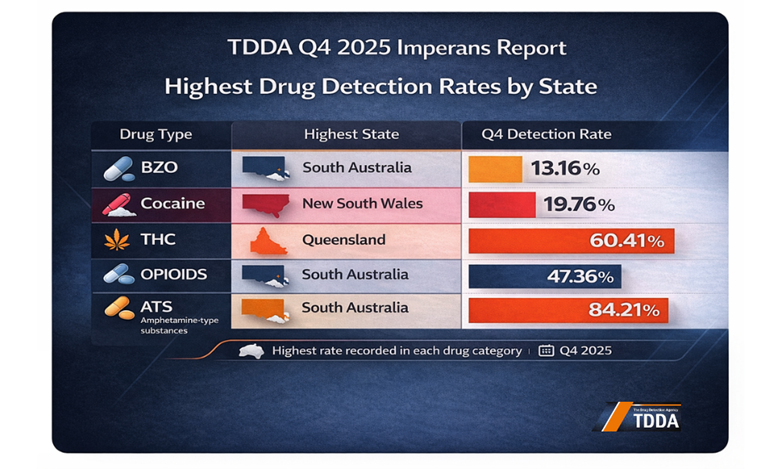
Methodology: Tests from 19 sterile clinic locations and over 50 mobile clinics throughout Australia were used. All tests were taken between 1 October and 31 December 2025. Data from preemployment, post incident, regular and random testing has been combined. Testing methods included urine and oral fluid screening. Data is reported into, anonymised, and aggregated using TDDA’s Imperans system, a bespoke IT platform for testing services, data recording, and reporting. It represents a snapshot of drug trends across Australasian workplaces and industries.
Total figures on testing volumes or testing results by industry and region are commercially sensitive.
TDDA drug tests screen for amphetamines; benzodiazepines; cocaine; methamphetamine; opiates and opioids; cannabis; and synthetic drugs.
ENDS
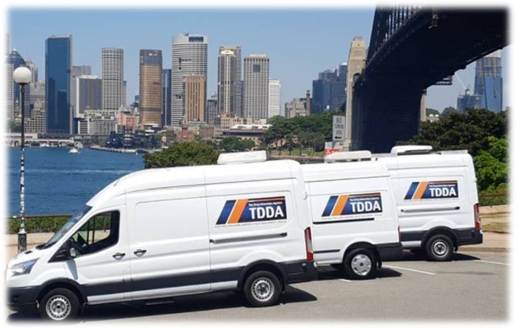
TDDA vans in front of the Sydney Harbour Bridge
For more information, or to speak with a TDDA spokesperson, please contact:
Richelle Gillett
Giant Squid Inc
0418 781 610
rg@giantsquidinc.com.au
About the Imperans Report
The Imperans report addresses an information gap for business. Government organisations like Safe Work Australia and state regulators such as WorkSafe Victoria and SafeWork NSW, publish incident reports, but they do not quantify when substances are a factor. Reports build businesses’ understanding of substance use patterns regionally and temporally so that they can anticipate and reduce workplace risks. TDDA provides over 100,000 tests every year.
About The Drug Detection Agency
The Drug Detection Agency (TDDA) is a leader in workplace substance testing with more than 300 staff, 90 mobile health clinics, 65 locations throughout Australasia. TDDA was established in 2005 to provide Australian and New Zealand businesses with end-to-end workplace substance testing, education and policy services. TDDA holds ISO17025 accreditation for workplace substance testing in both AU and NZ. Refer to the IANZ and NATA websites for TDDA’s full accreditation details. As members of the National Drug and Alcohol Screening Association (NDASA) and the California Narcotic Officers Association (CNOA), TDDA closely follows and acts on global drug trends.
Learn more about TDDA by visiting https://tdda.com/.